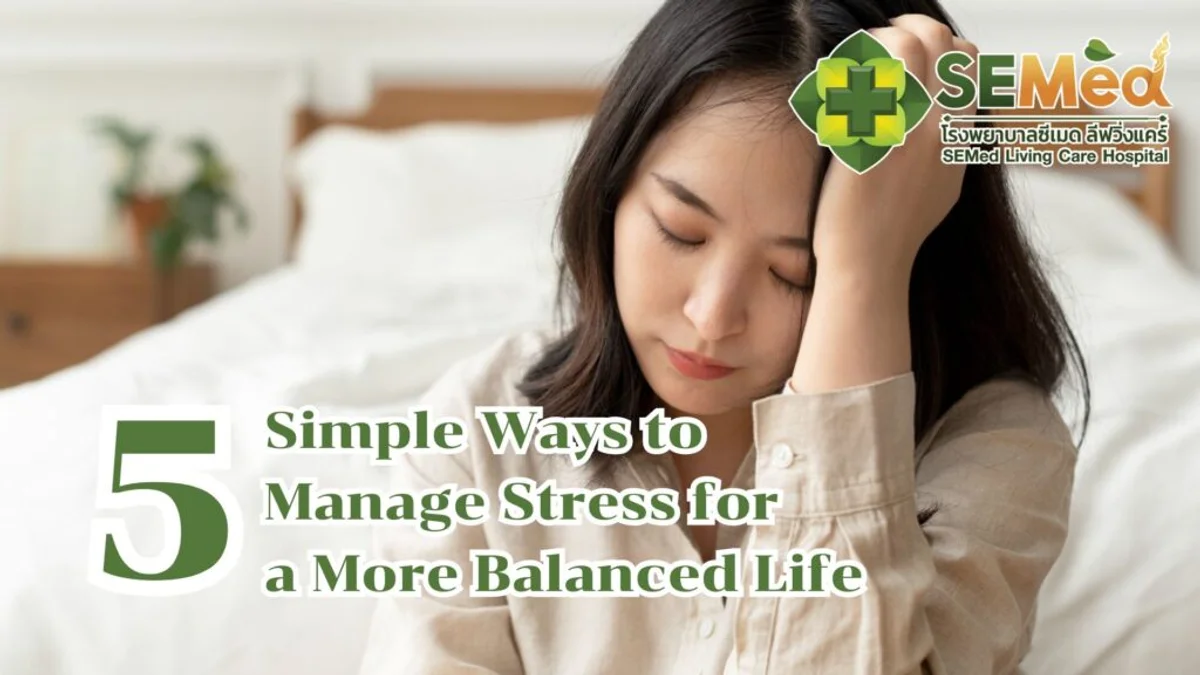
5 Simple Ways to Manage Stress for a More Balanced Life
5 Simple Ways to Manage Stress for a More Balanced Life
Stress is another serious threat that affects not only mental health but also physical health. Many people don't admit they're stressed, or most simply aren't aware of what exactly is causing their stress, which makes addressing stress difficult. Nowadays, a great many people accumulate stress to the point that it disrupts their mental balance, which can lead to depression, anxiety disorders, obsessive-compulsive disorder, or other mental health conditions. Let's look at how to live in a way that eliminates stress and achieves a better sense of balance.
3 Factors That Contribute to Stress
1. Personal Factors Contributing to Stress
Personal factors can be divided into both physical and emotional/mental aspects. Physically, stress may arise from illness, such as chronic conditions like diabetes, cancer, or other chronic diseases. Emotional and psychological factors refer to our level of emotional maturity, our ability to control our emotions in situations that don't go as we'd like, or even the inability to let go of problems once we encounter them — all of which can lead to stress.
2. Environmental Factors Contributing to Stress
The environment has a significant impact on mental state and stress levels, and this is easy to visualize. Imagine someone living in an overcrowded community full of drug users — they would live in constant fear and suspicion, leading to stress and a lower quality of life. This differs greatly from someone who lives in a beautiful home, in a good area with green spaces for relaxation, and who takes consistent care of themselves. The quality of life for these two groups differs greatly, and so does their level of stress. This doesn't apply to everyone, but it is certainly one possible contributing factor.
3. Social Factors, Including Unpredictable Situations
Society plays a significant role in stress. Remember that humans are social creatures — even if some people say they don't care much about socializing with friends, no matter where you are, you can still access society at any time. For those who are emotionally sensitive, the chance of being overwhelmed by society, leading to stress, is even greater. For example, nowadays everyone has social media, another channel that makes it very easy to see other people's lives. Some people even go as far as comparing their own lives to others, leading to discomfort that can easily turn into stress. This extends to unpredictable situations or events we never expected to happen, such as the various diseases and natural disasters we've experienced recently — things that are difficult to prevent — which create stress about the future for us.
Guidelines for Coping with Stress
1. Prioritize What Matters in Life: "Focus on What You Can Control and Let Go of What You Can't"
Although this may sound easy to say, we understand it's actually very, very difficult to do. But since stress has negative effects on us, training our minds is one very important thing to do.
2. Practice Mindfulness and Relaxation, Such as Meditation, Breathing Exercises, or Physical Exercise
"Mindfulness gives rise to wisdom" — many of you have probably heard this saying before. Mindfulness is something we can control, not just physically but also in terms of stress and mental state. Exercise is another activity that's very effective at relieving stress, because the body releases endorphins that create a sense of happiness, and while exercising we focus on just one thing, which may make us forget about our stress entirely.
3. Ask Someone for Help If Stress Becomes Too Much to Handle
When it comes to seeking advice, many people use this as an outlet for stress — it's believed that over 80% of people who do this at least talk to someone close to them, whether a friend, partner, or family member. But if a problem feels too overwhelming to handle, another option we recommend is to see a doctor or psychologist. Even though some people may be uncomfortable being told to see a psychiatrist, remember that they are professionals who can offer unbiased advice based on listening to you, and you may gain perspectives you hadn't considered before.
4. Create Life Balance — Make Time to Rest and Do Things That Make You Feel Good
Everyone should have something they enjoy doing, or an activity that makes them feel good, whether a little or a lot. Seeking out things that bring happiness will greatly help relieve stress — you may need to plan your schedule more carefully to make time for relaxing activities.
Mental health governs the body, as the saying goes. If you don't believe it, try observing yourself to see whether you currently have negative thoughts or unnecessary stress, and find a way to address it as quickly as possible. The sooner you resolve it, the better it will be for you. A clear mind leads to good health as well.
We are ready to provide academic support to businesses on various topics related to health and occupational medicine, offering attentive, fast, and effective health consultation services so that every customer is satisfied and gains maximum benefit.
Whenever you think of a health checkup, think of SEMed Living Care Hospital — we never stop working toward sustainable good health.
For more information
Tel.: 0-2199-2111 ext. 161, Marketing Department
or 081-358-6493 (Khun On), 086-368-5317 (Khun Ice)
Email: [email protected]
LINE: @semed
Facebook: SEMed living care hospital