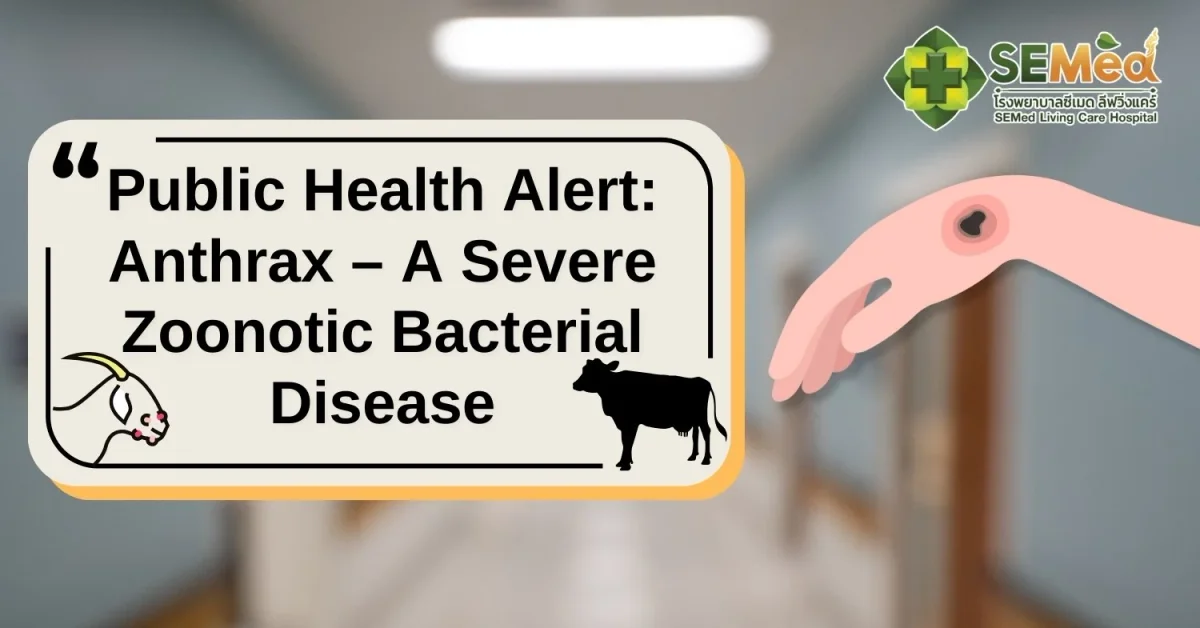
Anthrax Warning: A Dangerous Bacterial Disease from Animals to Humans
Anthrax: A Deadly Bacterial Disease Transmitted From Animals to Humans
Anthrax, sometimes called “kalee disease” by villagers, has been known since ancient times. Anthrax is recognized as one of the major epidemic diseases under Thailand's Animal Epidemic Act B.E. 2499 (1956). It is a serious, dangerous infectious disease that can occur in nearly all grazing animals, both wild animals such as elephants, barking deer, and deer, and livestock such as cattle, buffalo, goats, and sheep, and can then spread to humans and other animals such as tigers, dogs, cats, and pigs. The disease tends to occur in areas with a history of past outbreaks. This pathogen causes disease in humans in 3 forms: cutaneous (skin), pulmonary (from inhalation), and gastrointestinal/oropharyngeal (from ingesting the pathogen).
Cause
This disease is caused by a bacterium with the scientific name Bacillus anthracis, an aerobic, non-motile, spore-forming rod (1-1.25 x 3-5 μm) belonging to the family Bacillaceae. When a sample from a patient is Gram-stained, large square-ended Gram-positive rods are seen, either singly or joined in short chains. In dry conditions and unfavorable environments, it forms a protective spore coating around the cell, giving it strong resistance to heat, cold, and disinfectants, allowing it to survive in nature for decades.
Route of Transmission
Most human cases are contracted through the skin by contact with a sick animal or with animal products derived from a sick animal. This disease is most commonly found among people working in agriculture, as well as butchers, veterinarians, or those in close contact with sick animals. Humans become infected due to lack of awareness or insufficient caution, or sometimes due to poverty, where people butcher and eat meat from animals that have died. However, nearly every outbreak occurs in animals first, before spreading to humans. Cutaneous anthrax occurs when the bacterium enters the skin through an abrasion or wound. Pulmonary anthrax occurs from inhaling spores carried on animal hair or wool from an endemic area — respiratory transmission has never been reported in Thailand. Gastrointestinal and oropharyngeal anthrax results from eating meat from an animal that died of the disease without sufficiently cooking it. Animals usually become infected through both eating and breathing in spores present in fields where infected animals have previously died. However, in the early stages of an outbreak (late summer to early rainy season), animals become infected through eating and breathing at the same time — as an animal grazes and pulls up grass along with soil attached to the roots, anthrax spores clinging to the grass blades and soil enter through the mouth, while airborne dust containing spores is inhaled through the nose as the animal pulls up the grass.
Incubation Period
In humans, the time from infection to the onset of symptoms ranges from 12 hours to 7 days. However, in the case of inhaling spores used as a bioweapon, the incubation period can extend up to 60 days. In animals, the incubation period is usually short, especially in cases where the animal is infected through both eating and breathing in the pathogen.
Symptoms in Humans Occur in 3 Forms:
- Cutaneous anthrax Symptoms begin as a red bump at the site of infection, usually on exposed skin such as the hands, arms, or legs, though it can also occur on the torso or middle of the back, for example if someone removed their shirt while butchering an animal carcass. This initial bump develops into a clear blister, which darkens over time into a pustule that eventually ruptures into a raised-edge ulcer with a black, depressed center (black eschar), a characteristic feature of this disease. At the same time, if left untreated, new bumps will form around the original wound, gradually expanding outward. The area around the wound may sometimes become red and swollen, but the patient typically feels no pain, except in the nearby lymph nodes. Wounds caused by anthrax typically heal slowly if treatment is delayed, since they are necrotic wounds believed to result from the bacterium's toxin. The fatality rate without treatment is not particularly high, at around 5-20%.
- Intestinal anthrax A patient who eats meat or organs from an animal that died of this disease without cooking it sufficiently will, within 12-24 hours, develop fever, stomach discomfort, nausea, and vomiting resembling food poisoning. Without prompt treatment, inflammation and ulceration develop in the lymph nodes of the intestines and various parts of the bowel, along with fluid in the abdomen and severe abdominal pain. Sometimes clinicians may mistake this for appendicitis. Doctors treating such patients should therefore emphasize taking a detailed dietary history. Patients with these symptoms who develop diarrhea often have blood in their stool. If untreated, the bacterium enters the bloodstream, causing sepsis, which can be fatal. In this form, the fatality rate is as high as 50-60%.
Note: Some patients who chewed infected meat for a long time in their mouth developed sores in the mouth and throat (oropharyngeal anthrax). The lymph nodes in the neck become swollen and the swelling can spread to the face.
- Pulmonary anthrax Generally found in patients who work in industrial factories handling animal wool or bone meal where dust is airborne, and who inhale anthrax spores. Early symptoms resemble an upper respiratory infection, with fever and body aches, followed by shortness of breath, difficulty breathing, bluish skin discoloration, and death from respiratory failure within just 3-5 days after infection. The fatality rate for this form is very high, at 80-90%.
Prevention
- Avoid contact with infected animals or animal carcasses, especially in areas with a history of outbreaks
- Wear protective equipment when handling animals or carcasses, such as gloves, masks, and protective gowns
- Always wash your hands and equipment thoroughly after handling meat
- Choose meat that has been certified as safe food
- Do not eat raw or undercooked meat
We are ready to provide academic support to workplaces on a range of health and occupational medicine topics, offering health consultations and attentive, prompt, and effective service so that every customer is satisfied and gains the greatest benefit.
Whenever you think of a health check-up, think of SEMed Living Care Hospital. We never stop working towards lasting good health.
For more information
Tel: 0-2199-2111 ext. 161, Marketing Department
or 081-358-6493 (Khun On), 086-368-5317 (Khun Ice)
Email: [email protected]
LINE: @semed
Facebook: SEMed living care hospital
Reference: Department of Disease Control, Ministry of Public Health